


I remember talking to a patient who had been waiting eleven weeks for a neurology appointment. Eleven weeks — while dealing with worsening headaches, some vision changes, and a growing sense that something just wasn’t right. By the time she finally sat down with a neurologist, she was frustrated, anxious, and honestly a little defeated.
That story isn’t rare. It’s Tuesday in American healthcare.
Which is exactly why virtual neurology visits have started to feel less like a “nice to have” and more like something patients genuinely need access to. Not as a replacement for good clinical care — but as a smarter, more humane way to deliver it.
Here’s the Thing About Neurology and Convenience
Neurology isn’t like getting your blood pressure checked. The conditions involved — epilepsy, MS, Parkinson’s, stroke recovery, chronic migraines — are serious, often unpredictable, and require consistent monitoring over time. The problem is that consistent monitoring is hard to pull off when your nearest neurologist is 90 minutes away, or when you work a job that doesn’t offer flexible hours, or when the condition itself makes driving to appointments genuinely dangerous or exhausting.
The traditional model — show up, wait, see the doctor for 15 minutes, drive home — never actually worked that well for neurology patients. We just didn’t have a better option until recently.
Now we do. Practices like Advanced Associates In Neurology have built out real, substantive virtual neurology programs — not just “quick check-ins” but full clinical visits where patients get the attention and expertise their conditions require.
What a Virtual Neurology Visit Actually Looks Like
Forget whatever mental image you have of a choppy Zoom call. Done properly, a virtual neurology visit runs a lot like a regular appointment — just without the parking lot stress.
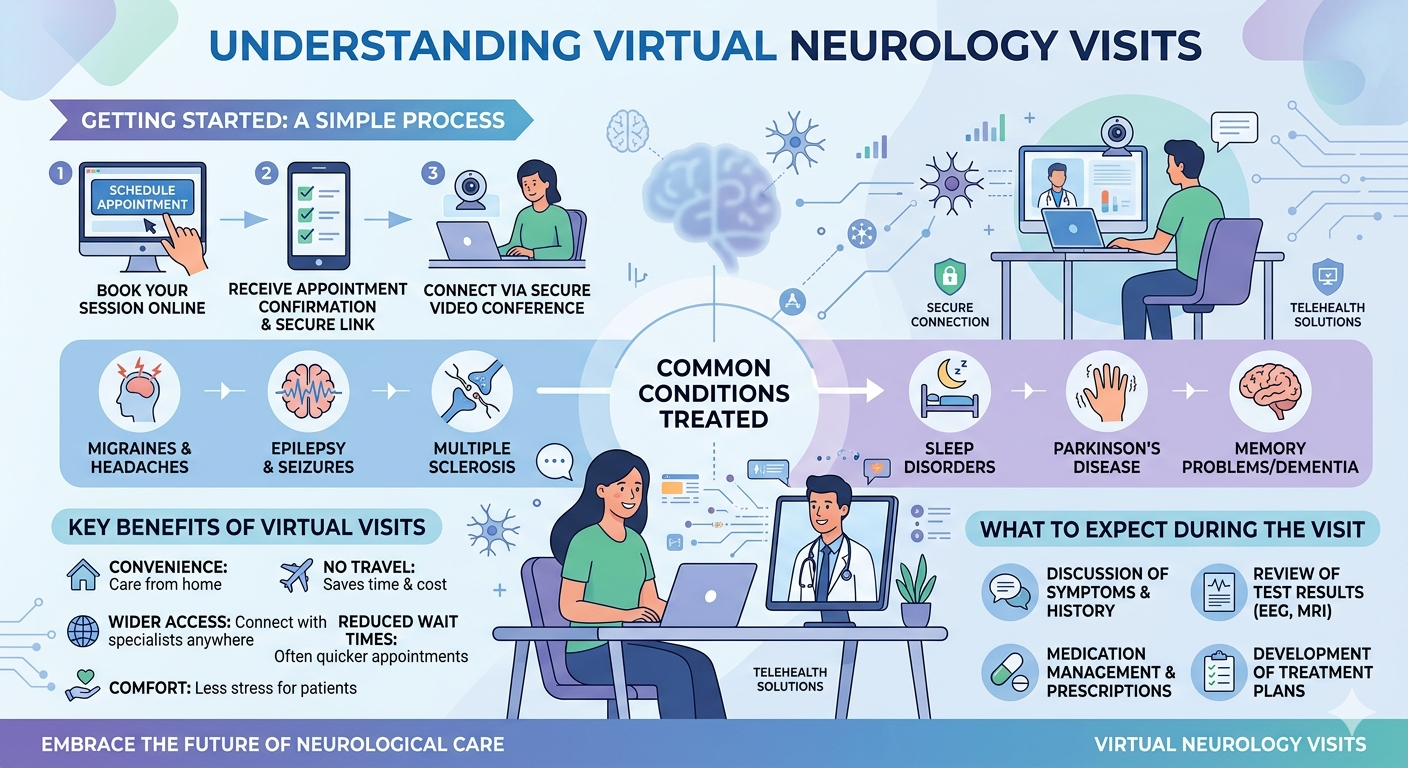
You connect over a secure, HIPAA-compliant video platform. Your neurologist reviews whatever records and test results you’ve uploaded beforehand. Then comes the actual conversation — your symptoms, how things have changed since your last visit, whether your current medication is working the way it should, what’s keeping you up at night. And yes, neurologists really can assess quite a bit through video. They’re trained to notice things — the way someone moves when they talk, slight facial asymmetries, eye movement, how words are formed. It’s not theater. It’s real clinical observation.
Where things genuinely require an in-person look — reflex testing, detailed sensory exams — your doctor will tell you that directly and get you scheduled accordingly. The goal isn’t to avoid in-person care. It’s to make sure you’re not wasting a four-hour round trip every single time you need a medication review.
The Conditions That Work Really Well With Telehealth Neurology
This is probably broader than you’d guess:
Migraines and headache disorders — Honestly, most migraine management is conversation-based anyway. Discussing frequency, identifying triggers, adjusting preventive medications — none of that requires you to be in the same room as your neurologist.
Epilepsy — Routine epilepsy follow-ups, medication adjustments, reviewing seizure diaries — all of this happens smoothly over video. Many epilepsy patients at Advanced Associates In Neurology have found they actually keep their follow-up appointments more consistently now that they don’t have to physically get there.
Multiple Sclerosis — MS fatigue is real and it’s significant. Asking someone in the middle of a flare to get up and travel to a clinic is asking a lot. Virtual visits let MS patients stay on top of their care during periods when showing up in person would be its own ordeal.
Parkinson’s Disease — Follow-up visits for Parkinson’s patients — checking in on motor symptoms, adjusting dosages, talking through daily challenges — translate well to telehealth. Especially for patients whose driving is already restricted.
Neuropathy and nerve pain — Ongoing symptom management, reviewing whether treatment is helping, coordinating with primary care — all doable virtually.
Memory and cognitive concerns — Early-stage consultations, follow-ups, family conversations about what comes next. This is an area where being at home can actually make patients more comfortable and communicative.
Post-stroke follow-up — Recovery from stroke is a long process. Virtual check-ins help keep that process moving without exhausting patients who are already working hard just to get through the day.
What to Do Before Your First Virtual Neurology Visit
The difference between a productive telehealth appointment and a frustrating one usually comes down to preparation. Here’s what actually helps:
- Write your symptoms down ahead of time. Not a vague summary — specific details. When did it start? How often? Is it getting worse? What makes it better or worse? You will forget things the moment the call starts if you haven’t written them down.
- Pull together your medication list — everything you’re taking, with dosages. Include supplements. Your neurologist needs the full picture.
- Upload any recent test results before the visit. MRI reports, EEG results, recent labs — get these into the patient portal in advance so your doctor can actually review them during the appointment rather than scrambling to find them.
- Check your tech the day before. Not the morning of — the day before. Camera working? Microphone clear? Internet stable? These things have a way of failing at the worst possible moment.
- Find a quiet, well-lit spot. Your neurologist needs to see your face clearly. Sitting with a window behind you makes that nearly impossible. A plain wall, good light in front of you — that’s all you need.
- Bring someone with you if it helps. A family member or caregiver can sit in, take notes, and ask follow-up questions. It’s worth doing for complex visits especially.
A Word on Insurance — Because Everyone Wonders
Yes, most insurance plans cover virtual neurology visits. That includes Medicare and Medicaid. Telehealth coverage expanded significantly over the past few years and most plans now treat virtual visits comparably to in-person ones.
That said — call your insurance before you schedule. Not because coverage is unlikely, but because plans vary and you don’t want a surprise bill. A five-minute call to member services can save you a headache later.
Who Should Still Come In Person?
To be completely straightforward about this: some situations are not virtual-visit situations.
If you’re having stroke symptoms — sudden facial drooping, arm weakness, slurred speech, severe sudden headache — that’s a 911 call, not a telehealth appointment.
First-time seizures, sudden significant vision changes, severe neurological symptoms that are new and rapidly worsening — these need in-person evaluation, urgently.
And some diagnostic work just can’t happen over video. If your neurologist needs to do a detailed physical exam, or if imaging is required, that’ll happen in person. A good virtual neurology practice will tell you clearly when that’s the case. The team at Advanced Associates In Neurology doesn’t push telehealth when in-person care is what’s actually needed.
Why This Actually Matters Beyond Convenience
There’s a tendency to frame telehealth as a convenience feature — something for busy professionals who don’t want to take a long lunch. But for a lot of neurology patients, virtual visits aren’t about convenience. They’re about access.
Patients in rural areas who live hours from the nearest neurologist. Patients with mobility limitations who can’t safely drive themselves. Patients who can’t afford to take unpaid time off for appointments. Patients managing conditions that cause fatigue so severe that leaving the house is genuinely hard some days.
For these patients, virtual neurology visits aren’t a luxury. They’re the thing that makes ongoing neurological care possible at all.
Advanced Associates In Neurology understands this — which is why their virtual neurology program is designed to deliver the same standard of care patients would receive face-to-face, just through a screen.
Ready to Try It?
If you’ve been putting off a neurology appointment — because of distance, scheduling, the hassle, or just not knowing where to start — a virtual visit is a genuinely good place to begin.
Contact Advanced Associates In Neurology to schedule your virtual neurology visit. Expert neurological care, from wherever you are.
FAQs — Stuff People Actually Ask
“Can a neurologist really figure out what’s wrong with me over video?”
For a lot of conditions, yes — especially if you’ve already had some diagnostic workup done. Neurologists are skilled observers and a detailed conversation about your symptoms covers more ground than people expect. That said, your doctor will always tell you if they need to see you in person. You won’t be left wondering.
“What if I need an MRI or bloodwork?”
Your neurologist orders those the same way they would after an in-person visit — digitally. You go to a local imaging center or lab, the results come back, and you review them together at your next appointment. The virtual visit kicks off the process; it doesn’t stall it.
“I’m not great with technology. Is this going to be a struggle?”
Probably not. Most telehealth platforms are genuinely simple — you get a link, you click it, you’re in. No downloads required in most cases. And the staff at Advanced Associates In Neurology will walk you through it before your appointment if you need a hand. You don’t have to figure it out alone.